
Available under certain conditions, the French long-term resident card -Carte de résident- is a residence permit valid for 10 years and renewable. Do you reside in France permanently and wish to apply for your first resident card? Starting in 2026, the process for obtaining this long-term residence permit will become more complex. In fact, the French language requirement for the residence permit has changed: level A2 is no longer sufficient; a B1 level is now required. Additionally, you must also pass the Examen civique---a written test designed to assess your knowledge of French culture and society.
We will break down these changes to help you effectively prepare your application for a residence card.
According to the latest information available on the Formation Civique website of the French Ministère de l'Intérieur.
What level of French is required for a residence card (Carte de résident) in 2026?
As of the 1st of January 2026, the minimum French proficiency level required for a first-time application for a long-term resident permit will be B1. (Until 2025, the A2 level was required.) You must also pass a civic exam-the Examen civique-, which is also aligned with the B1 level in French. Improving your French skills is therefore essential to ensure your application for a residence card is approved on the first try.
What does the B1 level in French correspond to?
Level B1 is the first level in the "intermediate" category of the Common European Framework of Reference for Languages.
In practical terms, this means that you must:
- be able to handle everyday situations independently;
- be able to understand and hold a simple conversation;
- be able to express yourself clearly on topics you are familiar with.
Are you having trouble assessing your level and understanding these new requirements for the residence card ?
We have prepared a comparison chart of the B1 level requirements versus the A2 level:
| Skill | A2 | B1 |
|---|---|---|
|
Listening comprehension |
Understands simple sentences and frequently used expressions (work, family, shopping). |
Understands the main points of a clear conversation on familiar topics. |
|
Reading comprehension |
Understands short, simple texts (announcements, short messages). |
Understands texts written in common language (simple articles, professional emails).. |
|
Speaking production |
Can describe in simple terms their family, work, environment. |
Can express themselves simply but coherently on familiar subjects. |
|
Oral interaction |
Can communicate on simple topics if the interlocutor speaks slowly. |
Can participate in a conversation on familiar topics without excessive preparation. |
|
Writing |
Can write short, simple messages. |
Can write a simple, coherent text (email, short letter). |
Do you need to improve your French skills to achieve the B1 level?
At École Suisse, we offer customised programmes to help you make rapid progress in French and prepare for official exams.
► Find out more about our DELF preparation programme
► Find out more about our TCF and TEF preparation programmes
Which language tests are accepted for the French resident card?
To certify your French proficiency as part of a residence card application, you must submit proof of passing a test or an official diploma. Here are the various French exams recognised for this process.
The TCF and the TEF
- The Test de Connaissance du Français (TCF) is administered by France Éducation International.
- The Test d’Évaluation de Français (TEF) is administered by the Chambre de Commerce et d’Industrie de Paris.
These two official tests assess all aspects of French proficiency: listening comprehension, reading comprehension, mastery of language structures, written expression, and oral expression.
Both French tests are primarily administered on a computer and consist of multiple-choice questions. They also include an oral expression component with an examiner.
The TCF and TEF at the B2 level are valid for 2 years.
The DELF B1
The DELF (Diplôme d’Études en Langue Française) is issued by the French Ministry of National Education. It is an official diploma aligned with the levels of the Common European Framework of Reference for Languages, and its results are valid for life.
Like the TCF and the TEF, it assesses all aspects of French proficiency and includes an oral exam.
💡 Note: If you already hold a degree issued in France (baccalauréat, bachelor's, master's), you do not need to take a French test or exam.
How long does it take to reach level B1 in French?
It's hard to give a precise answer to this question. It really depends on each person's learning ability, as well as your starting level and how consistently you take French classes. On average, however, it takes several weeks---or even several months---to move from one level to the next.
Already at the A2 level in French? With intensive classes and a good investment of time you can reach the B1 level in 2 to 3 months. Please note that this timeframe is only an estimate; it can vary significantly from person to person.
French citizenship test: a new requirement for the long-term residence permit
Passing the Examen civique is one of the new requirements for a French resident card (first application). Introduced on the 1st of January 2026, this civic exam aims to assess your knowledge of French societal values, history, and culture.
How does the civic exam work in practice? It is a written test taken on a computer. It consists of 40 questions and lasts 45 minutes. You must answer 80% of the questions correctly to pass, meaning you must answer 32 out of 40 questions correctly.
The questions are broken down as follows:
- 28 questions are multiple-choice questions (MCQs);
- 12 questions are scenario-based (you will need to apply your knowledge in a specific context).
Please note:
- The level of the civic exam corresponds to the minimum level required for a residence permit, which is B1 for a resident card application.
- The Examen civique is mandatory only for first-time applications. If you are applying to renew your resident card, you do not need to take the French citizenship test.
The topics covered in the Examen civique are as follows:
|
Principles and Values of the French Republic |
|
|---|---|
| French Institutional and Political System (6 questions) |
|
| Rights and Duties of Citizens (11 questions) |
|
| History, Geography, and Culture (8 questions) |
|
| Living in French Society (4 questions) |
|
What training should you take to obtain a residence card in France?
French classes
Do you think you're not at the B1 level? You will likely need to take French classes to prepare for your application for a residence card. To reach your goals quickly, opt for intensive French classes: with dedication and personal effort, you'll see your first signs of progress in just a few weeks.
Be sure to also look into French language exams. Taking specialised prep courses can help you fully understand what is expected on the test you plan to take. The result: you will feel confident on exam day and give yourself the best chance of achieving the level you are aiming for.
Let the École Suisse guide you
The requirements for a residence card are becoming increasingly stringent. To give yourself the best possible chance of success, École Suisse has developed a personalised programme to help you prepare for the civic exam. Through expert guidance and practical exercises, you will deepen your understanding of French society and the values of the Republic.
At the same time, you will make rapid progress in French with École Suisse. With over 100 years of experience teaching French to non-native speakers, we will guide you step by step toward achieving the B1 level required for your residence card application. As a small, family-friendly school nestled in the heart of Paris, we offer customised programmes tailored to your level and goals. You are no longer on your own: you can count on our French teachers and their extensive teaching experience to support you in your learning journey.
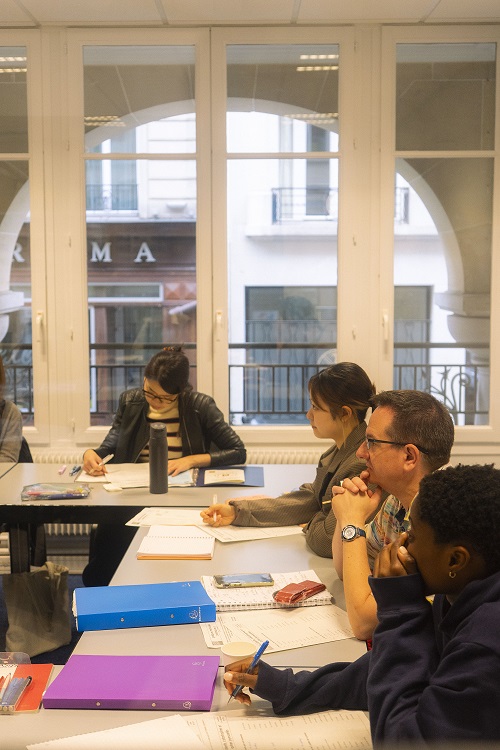
Would you like to learn French in a relaxed setting, with personalised support to quickly reach the B1 level? Visit us at 10 rue des Messageries or contact us for more information about our programmes.
► Discover our French courses in Paris
FAQ - Applying for a French Resident Card (Carte de résident)
What language level is required for a residence card in France in 2026?
Level B1 is now mandatory for a first-time application. (Until 2025, Level A2 was required.)
Is level A2 still sufficient to obtain a residence card in France?
As of the 1st of January 2026, level A2 is no longer sufficient for a residence card. You must now demonstrate a B1 level in French. However, level A2 is sufficient for an application for a multi-year residence permit.
I need to apply to renew my residence card; does the reform affect me?
No, the reform of residence permits applies only to initial applications.
How long does it take to go from A2 to B1 in French?
The time it takes to reach level B1 varies from person to person. It can depend on your learning abilities, as well as the pace of your classes and the amount of time you can devote to them each week. In general, it takes several weeks, or even several months, to progress from level A2 to level B1.
Which French test or exam should you take for a residence permit?
You must take an officially recognised test or exam. You can choose between the TEF, the TCF, or the DELF.
Is the civic exam mandatory for the first application for a French resident card?
Yes, since January 2026, you must pass a French citizenship test for any first application for a residence card.
Source : Formation Civique, French ministère de l’Intérieur