
2026 marks a reform of the procedures for obtaining residence permits and naturalisation.
On the one hand, the required French language proficiency levels are higher today.
And, on the other hand, passing a new citizenship test—the Examen civique—is now mandatory.
Let’s take a look at this new law, which took effect on the 1st of January 2026.
According to the latest information available on the Formation Civique website of the French Ministère de l'Intérieur.
Naturalisation or residence permit: who is affected by the Examen civique?
Since 2023, the government has undertaken a major reform of immigration law, particularly for those wishing to settle in France. If this applies to you, you must now demonstrate that you understand the values of the Republic, how French society functions, and the country’s culture.
As part of this, passing a French citizenship test - called Examen civique - is now mandatory for certain procedures. A new law taking effect on the 1st of January 2026 applies to the following applications:
- multi-year residence permits: a residence permit valid for 2 years or more, which applies, among others, to students or employees who have already spent at least one year in France;
- resident cards: permanent, renewable residence cards valid for 10 years;
- naturalisation by decree: in this case, it is no longer a residence permit but a process for obtaining French citizenship.
Please note:
- The 2026 reform of residence permits applies only to initial applications. Renewal applications are not affected.
- In the case of a naturalisation application, the Examen civique does not replace the prefecture interview that already existed. It is added to the existing procedure.
First 2026 reform: A higher level of French
Starting in 2026, you must demonstrate that your level of French allows you to integrate into daily life in France. To this end, the Ministry of the Interior has raised its requirements for language proficiency certification. Thus, you must now provide proof of:
- an A2 level for the multi-year residence permit (whereas, until 2025, an A1 level was required);
- a B1 level for the resident card (whereas, until 2025, an A2 level was required);
- a B2 level for any naturalisation application (whereas, until 2025, a B1 level was required).
To this end, you will be required to submit proof of passing an official French test (TEF or TCF) or a diploma (DELF) to certify your level.
👉 Need to improve your French to pass your exam?
► Find out more about our DELF preparation programme
► Find out more about our TCF and TEF preparation programmes
French language tests accepted for naturalisation and residence permit applications
To be valid for administrative purposes, your French test must be an officially recognised, internationally accredited test. You may therefore take one of the following three tests or exams:
- the TEF (Test d’Évaluation de Français);
- the TCF (Test de Connaissance du Français);
- or the DELF (Diplôme d’Études en Langue Française).
The TEF and TCF are valid for only 2 years, but the DELF is valid for life.
Note: If you hold a degree obtained in France (baccalaureate, bachelor’s, master’s), you do not need to take a French test or obtain a French language certificate.
Second reform of 2026: The requirement to pass a French citizenship test
As of the 1st of January 2026, obtaining a certificate of passing the Examen civique has become a mandatory requirement for any application for a multi-year residence permit, a resident card, or naturalisation.
What is the Examen civique?
This French citizenship test is a written test designed to assess your knowledge of French societal values and culture.
Topics covered by the civic exam in 2026
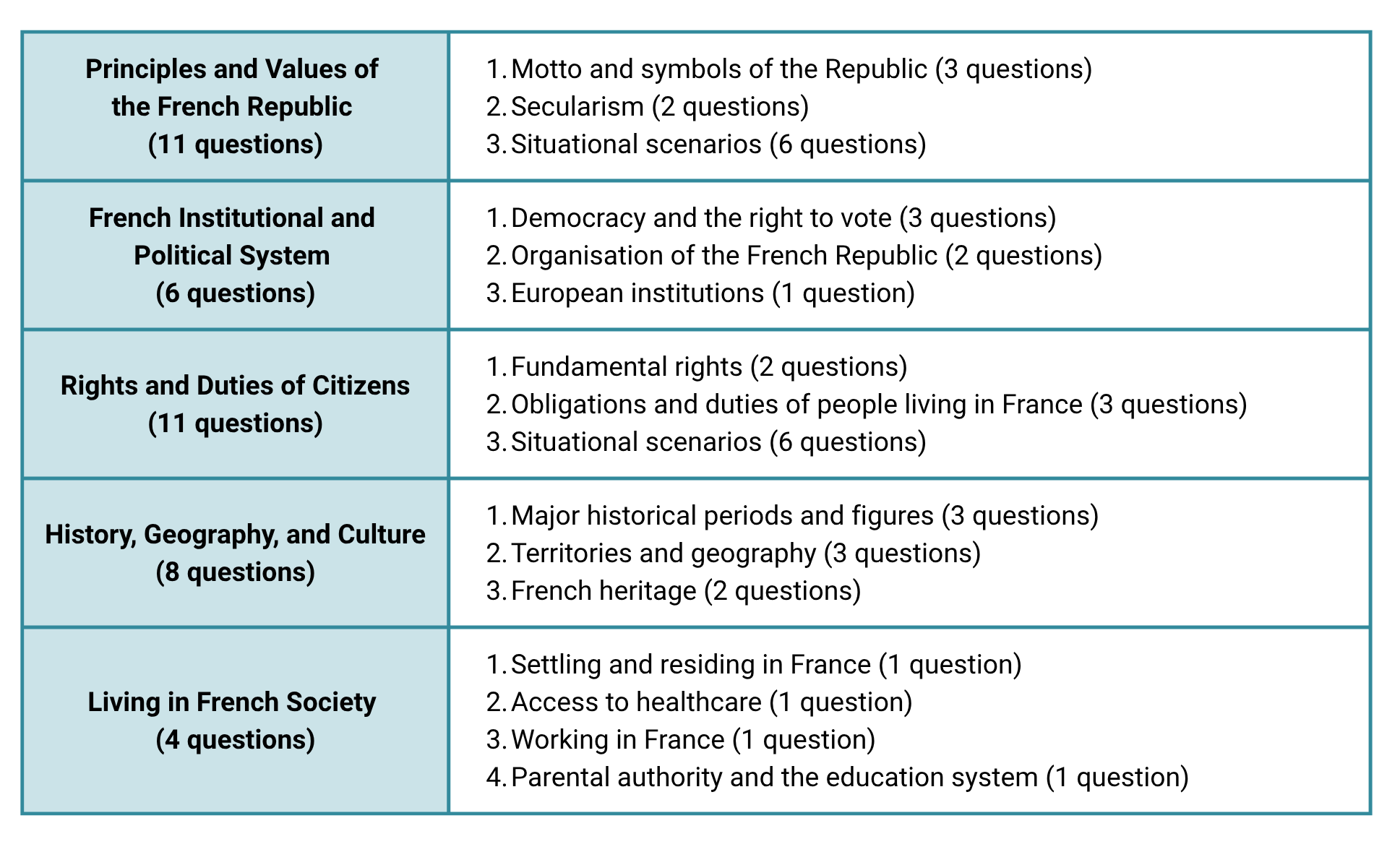
The questions on the citizenship test are designed to assess your knowledge of five topics, which are:
- the principles and values of the Republic;
- the French institutional and political system;
- the rights and duties of citizens;
- French history, geography, and culture;
- life in French society.
How the French citizenship test works
The Examen civique is taken on a computer. It lasts approximately 45 minutes, during which you must answer 40 questions.
28 questions are multiple-choice questions (MCQs) on knowledge related to the topics listed above. For each question, 4 answers will be provided, among which there is only one correct answer. The scoring scale is as follows: 1 correct answer is worth 1 point; 1 incorrect answer and no answer are worth 0 points.
12 questions are scenario-based. For these questions, you will need to apply your knowledge of French society to a specific context or case.
The questions on the Examen civique are distributed as follows:
Source : Formation Civique, French Ministère de l'Intérieur
Requirements for passing the Examen civique
To pass the French citizenship test, you must answer 80% of the questions correctly, or 32 out of 40 questions. Your civic exam result is valid for life.
⚠️ Important: The level of the Examen civique you take corresponds to the language proficiency required for the administrative application you are pursuing, namely:
- A2 for a multi-year residence permit,
- B1 for a resident card,
- B2 for naturalisation.
How can you effectively prepare for the civic exam?
Improve your French
Improving your French language skills may be necessary to reach the required level, but also to feel more comfortable when taking your civic exam.
To do this, sign up for French classes to practise both speaking and writing. Keep in mind that moving from a B1 to a B2 level can take time. Therefore, opt for intensive and regular classes to ensure you make rapid progress.
The École Suisse is here to support you
Are you planning to apply for a residence card or naturalisation? Thorough preparation for your French citizenship test will give you the best chance of success and reduce the likelihood of your application being postponed.
The École Suisse offers customised programmes to:
- improve your French skills and reach level B1 or B2;
- prepare for the civic exam with tips and practice exercises;
- practise answering questions from the naturalisation interview.
👉 Would you like to learn more?
► Check out our DELF preparation programme
► Check out our TCF and TEF preparation programmes
FAQ - 2026 French citizenship test
Who is required to take the Examen civique in 2026?
As of the 1st of January 2026, the requirement to pass the French citizenship test applies to all individuals applying for a multi-year residence permit (first application), a resident card (first application), or naturalisation.
Can you be exempted from taking the Examen civique?
Individuals over the age of 65, as well as those whose health condition or disability makes it impossible to take the test, may be exempted or granted accommodations.
Where can I take the 2026 civic exam?
To take the civic exam, you must register with a centre approved by the Chambre de Commerce de d’Industrie de Paris or by France Education International.
What level of French is required in 2026 for a multi-year residence permit?
For the multi-year residence permit, the minimum level required is now A2, whereas, until 2025, level A1 was required.
What level of French is required in 2026 for a resident card?
For the resident card, the minimum level required is now B1, whereas, until 2025, level A2 was required.
What level of French is required in 2026 for naturalisation?
For naturalisation, the minimum level required is now B2, whereas until 2025, the B1 level was required.
What is the difference between levels B1 and B2 in French?
Level B1 is an intermediate level. At this level, you can manage in everyday situations.
Level B2 is an upper-intermediate level. At this level, you should be able to understand complex situations and express yourself fluently.
How long does it take to go from level B1 to level B2?
It depends on the individual and their learning pace, but on average, several months of regular study are needed to reach level B2.
Can you retake the French citizenship test if you fail?
Yes. If you fail, you can re-register and retake the exam. It is recommended that you prepare thoroughly before attempting it again.
Source: Formation Civique, French Ministry of the Interior